Partner Antonio Dodero
Queer Places:
Av. Hidalgo 123, Centro Histórico de la Cdad. de México, Guerrero, Cuauhtémoc, 06300 Ciudad de México, CDMX, Mexico
Panteón Español, Miguel Hidalgo, 11230 Mexico City, Mexico
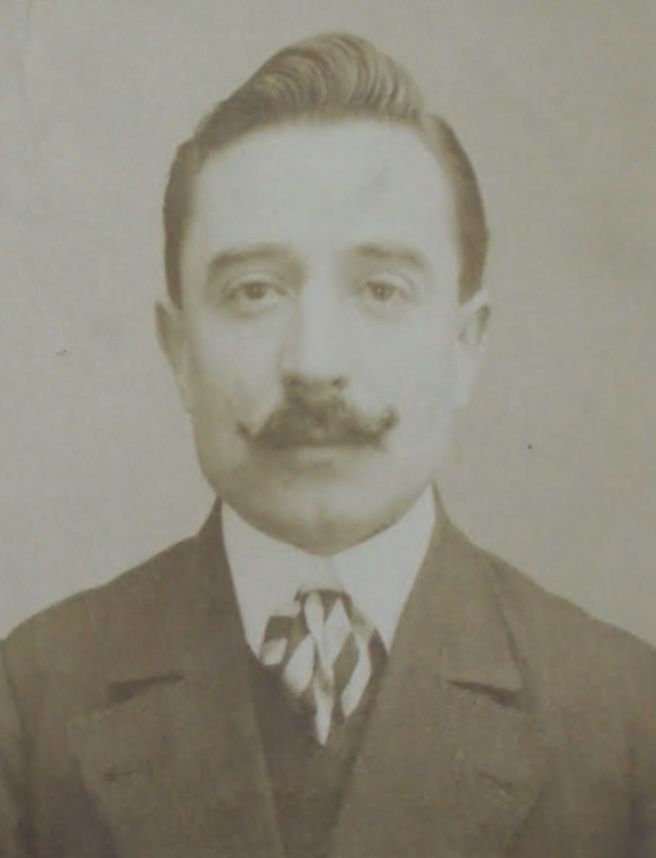 Antonio Adalid Pradel (January 23, 1873 - February 18, 1939), whose full birth name was Jose Antonio Ildefonso Ignacio Francisco Adalid Pradel, was born
on January 23, 1873, in the Cuauhtémoc Borough of Mexico City, Mexico, and was baptized at Santa Veracruz on February 1, 1873. He was the son of Don
Joaquin Adalid Sánchez de Tagle, an equerry to Emperor Maximilian I who ruled Mexico from 1863 to 1867, and María del Refugio Pradel Herrera. Coming from
a wealthy and prominent nineteenth-century Mexican family, Antonio was notably a godson of Emperor Maximilian I and Empress Carlota of Mexico. During his
teenage years, he was sent to the United Kingdom to be educated, while his older brother Pepe remained behind to manage the family estates.
Antonio Adalid Pradel (January 23, 1873 - February 18, 1939), whose full birth name was Jose Antonio Ildefonso Ignacio Francisco Adalid Pradel, was born
on January 23, 1873, in the Cuauhtémoc Borough of Mexico City, Mexico, and was baptized at Santa Veracruz on February 1, 1873. He was the son of Don
Joaquin Adalid Sánchez de Tagle, an equerry to Emperor Maximilian I who ruled Mexico from 1863 to 1867, and María del Refugio Pradel Herrera. Coming from
a wealthy and prominent nineteenth-century Mexican family, Antonio was notably a godson of Emperor Maximilian I and Empress Carlota of Mexico. During his
teenage years, he was sent to the United Kingdom to be educated, while his older brother Pepe remained behind to manage the family estates.
As a young adult in high-society Mexico City, Adalid became a prominent figure in the capital's elite circles and was widely known by the nickname
"Toña la Mamonera" or "Toña la Maromera," often engaging in transvestism. He achieved historical notoriety as one of the central organizers of the
infamous Dance of the Forty-One, a major early twentieth-century Mexican social scandal under the presidency of Porfirio Díaz. On November 17, 1901, a
private party held on Calle de la Paz in Colonia Tabacalera was raided by police, resulting in the arrest of forty-one men, half of whom were dressed in
women's clothing. During the festivities, a notorious raffle of a rent boy had taken place, won by Adalid as the highest bidder. This young man was
twenty-year-old Antonio Dodero, who was also arrested in feminine attire. Although Adalid was implicated as an organizer and his family bribed
authorities to secure his release since he was not wearing women's clothes at the exact moment of the raid, the ensuing public scandal caused his father,
Don Jose, to disown and disinherit him.
Following the scandal and his family's rejection, Adalid fled to the United States, settling penniless in California with very few job prospects. Upon
arriving, he went to confession, and a local priest assisted him in securing employment as a Spanish teacher at a Saint Mary college. Antonio Dodero
eventually tracked Adalid down in the United States, and the two began a lifelong partnership, living together in Alameda, California, until 1920.
In the early 1920s, Adalid was permitted to return to Mexico under the condition that he married a woman, a tactical arrangement that allowed him to
claim a small inheritance from his mother. Upon his return, he began teaching English at the National Preparatory School in Mexico City. He and Antonio
Dodero set up a home together in a subdivided, elegantly decorated apartment at 123 Avenida Hidalgo, adjacent to San Fernando Square. Publicly presenting
themselves as uncle and nephew to maintain discretion, the couple established their home as a crucial hub for an intergenerational homophile social
network.
The Adalid and Dodero residence became a vibrant center of domesticity, culture, and sociability that nurtured early Mexican gay identity. Their
one-bedroom flat featured colonial antiques, travel mementos, and portraits of the couple, welcoming a sophisticated circle of prominent political
figures, artists, and intellectuals. Among their regular guests were cabinet ministers Luis Montes de Oca,
Genaro Estrada, and Jaime Torres Bodet; poets
Xavier Villaurrutia and Salvador Novo; and painters
Agustín Lazo Adalid and Roberto Montenegro. Older friends
within this network used the space to mentor younger men, introduce acquaintances, pass along sexual knowledge, and recommend trusted physicians.
Salvador Novo later fondly recorded these evenings in the 1950s, recalling how Adalid and Dodero would prepare snacks, serve Chinese take-away, and wash
dishes, establishing a domestic model that younger generations of gay men eagerly replicated.
Antonio Adalid Pradel lived out his later years in Mexico City, passing away on February 18, 1939, at the age of sixty-six in Colonia Juarez,
Cuauhtémoc Borough, Mexico City. He was subsequently buried in the Panteón Español located in the Miguel Hidalgo Borough.
References:
Other references:
- Obituario GLBTTTI Mexicano: A biographical digital archive and record source detailing his life dates and historical context ([http://obituarioglbttti-mexicano.blogspot.com/2010/10/antonio-adalid-pradel.html](http://obituarioglbttti-mexicano.blogspot.com/2010/10/antonio-adalid-pradel.html)).
- Memoirs and Writings of Salvador Novo: Accounts and recollections written by Mexican poet and intellectual Salvador Novo (frequently cited through the 1950s, including references in works like La estatua de sal), who fondly recorded details of Adalid and Antonio Dodero's refined company, domesticity, and social gatherings.
- The Transnational Homophile Movement and Cultural History Research: Historical and academic analyses examining the development of domesticity, networks, and homophile sociability in Mexico City, mapping out intersections with prominent political figures, cabinet ministers (such as Luis Montes de Oca, Genaro Estrada, and Jaime Torres Bodet), and artists (such as Xavier Villaurrutia, Agustín Lazo Adalid, and Roberto Montenegro).
- Press and Archival Records of the Dance of the Forty-One (El baile de los cuarenta y uno): Contemporary early-20th-century media reports, popular broadsides, and historical assessments from the era of President Porfirio Díaz documenting the November 17, 1901 police raid, subsequent exiles, and elite social circles.
- Vital Statistics and Civil Registrations: Official birth, baptismal (Santa Veracruz, February 1, 1873), and death records (Colonia Juarez, February 18, 1939) alongside burial documentation from the Panteón Español in Miguel Hidalgo, Mexico City.
Support this project
This website is a passion project researched, developed, and funded entirely by me. If you find the content valuable and would like to help support the ongoing research and hosting costs, any contribution is deeply appreciated.
Thank you for keeping this independent resource alive!
My books on Amazon: Elisa Rolle's books
BACK TO HOME PAGE